



































The Centre Pompidou has one of the most recognisable visual identities in European culture. Its exposed structure, external escalator and brightly coloured services have defined the Beaubourg building since it opened in Paris in 1977. Even its logo, designed by Jean Widmer, reduces the façade and its famous “caterpillar” escalator to a few graphic lines.
When the institution developed a new merchandise range, this architectural identity provided the starting point. The collection included notebooks, tote bags, mugs, T-shirts and patches, but one product introduced a different cultural reference: a knitted supporter scarf.
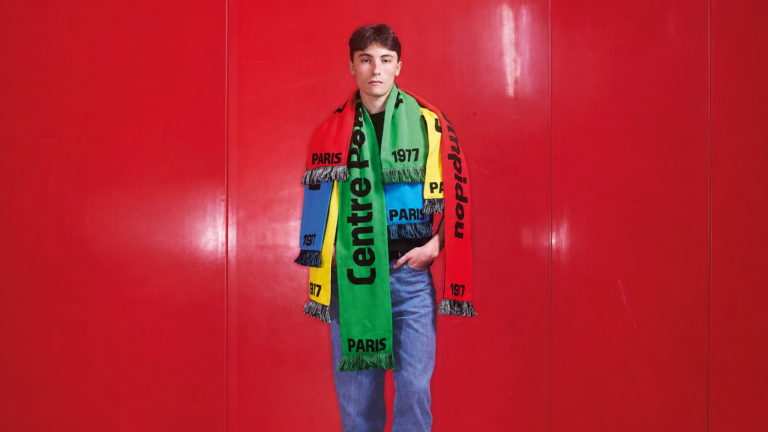
Available in four strong colourways, the custom supporter scarves brought a format normally associated with stadiums into the Centre Pompidou boutique. They were designed for public sale, but their role extended beyond conventional museum retail. The scarves were also used for internal presentations, press activity, photography, partners and other stakeholders.
Hercules Merchandise became involved once the product’s place within the collection was clear. The task was to produce a scarf that retained the recognisable character of supporter merchandise while meeting the design and presentation standards expected of an internationally known cultural institution.
From architectural colour code to retail collection
The blue, yellow, green and red versions of the scarf were not arbitrary colour choices. Each came from the functional colour code devised for the Centre Pompidou building by architects Renzo Piano and Richard Rogers.
Blue represents airflow and air-conditioning. Yellow identifies electricity, while green is used for water circuits. Red marks pedestrian circulation, including the lifts and external escalators. Rather than concealing the building’s technical systems, the architecture turns them into part of its public identity.
That connection gave the scarves a clear place within the wider “Gamme logo”. The official Centre Pompidou architecture guide explains the origins of these colours, while the museum boutique presents the collection as being based around the institution’s emblematic palette and iconic architecture. The same colours appear across several products, creating a coherent range without requiring every item to reproduce the building literally.
On the scarves, the colours worked particularly well because knitted supporter products benefit from strong contrast and uncomplicated graphics. Centre Pompidou’s name, its logo, “Paris” and the opening year “1977” could be read easily from a distance. Together, those elements made each scarf specific to the institution and its historic Paris location.
Why a supporter scarf worked for a museum
A museum shop traditionally offers books, prints, stationery and design objects. A scarf introduces a more public and participatory type of merchandise. It can be worn in the building, used at an event, included in photography or displayed as part of a retail collection.
The word “supporter” also works beyond sport. Visitors may feel a genuine attachment to a museum, music venue, city or cultural institution. The scarf gives that affinity a familiar visual form without requiring the organisation to imitate a football club.
For Centre Pompidou, the format suited an institution with a broad public identity. The building itself is part museum, part Paris landmark and part piece of popular culture. A knitted scarf felt accessible alongside the more conventional design-led products in the boutique.
This is something we regularly see when producing custom scarves for organisations outside sport. The strongest projects do not simply place a corporate logo on a football product. They identify which characteristics of the scarf fit the organisation and adapt the design accordingly. In this case, bold typography, architectural colours and the date of inauguration supplied all the necessary material.
A retail product prepared for several audiences
The original scarves measure 140 × 18 cm and are made from 100% acrylic yarn in the European Union. They are finished with fringes and were produced in four versions: blue, yellow, green and red.
Those specifications gave Centre Pompidou a practical retail item at an accessible price point. The scarves are currently presented in the official Centre Pompidou shop alongside matching pieces from the wider collection.
Retail suitability involved more than the knitted design. Labels, EAN information and folded presentation were relevant because the products had to work in an e-commerce and museum-shop environment. Colour accuracy also carried unusual importance. With each version referring to the architecture, a colour could not be treated merely as a close decorative alternative.
The scarf nevertheless had several audiences. It could be purchased by a visitor, worn by a member of staff during an activation, used in a product shoot or given to a partner. That versatility distinguished it from a souvenir designed solely for shelf display.
For brands and cultural organisations exploring custom football scarves, the project offers a useful model. The construction can remain recognisably that of a supporter scarf while the graphic language comes entirely from the organisation’s own history and visual identity.
A scarf for Beaubourg’s final celebration
The scarves entered the collection during an important period for the Centre Pompidou. Its Paris building closed in autumn 2025 ahead of a major renovation, with reopening planned for 2030. Rather than pausing its programme, the institution began operating through partner venues in France and abroad as part of its Constellation programme.
On 24 and 25 October 2025, the building was celebrated with Because Beaubourg, a closing festival organised with Because Music. Nearly 40,000 people attended what the Centre Pompidou described as the largest event ever held at Beaubourg.
Concerts, performances, workshops, talks and installations occupied the building’s eight floors. The programme included projects by Justice and Thomas Bangalter, alongside appearances from artists including Christine and the Queens, Aya Nakamura, Catherine Ringer and Keziah Jones. A roller disco took over the upper level, while the Forum became the centre of the night-time programme.
The scarves were suited to this setting because they already combined the institution’s identity with the visual directness of event merchandise. They could sit in a temporary retail space, feature in campaign imagery or be worn by people taking part in the final celebrations. The product was connected to the building without becoming a miniature reproduction of it.
This timing also gave “Paris” and “1977” additional resonance. As the historic building entered a five-year period of renovation, the scarf offered a simple, wearable connection to the original Beaubourg site.
From a successful range to Centre Pompidou Francilien
The reception of the first range led to a further scarf project for the Centre Pompidou Francilien – fabrique de l’art in Massy. This was not simply a repeat order in another colour. The new product had to maintain continuity with the Paris scarves while representing a new place and a different institutional moment.
The Massy site will be a 30,000 m² centre for conservation, restoration, exhibitions and artistic creation. It will include storage facilities for the Centre Pompidou’s collection, specialist workshops and spaces open to visitors. Its architecture also creates a link with Beaubourg: the large timber staircase and walkways facing the park recall the external circulation of the Paris building.
A series of free “Prélude!” preview weekends will introduce the site in October 2026. Its full public opening is scheduled for spring 2027. The new scarf is intended primarily for VIP gifting around the launch, with the possibility of additional quantities for sale.
At 160 × 18 cm, the Massy model is slightly longer than the original retail scarf. It uses three colours, acrylic yarn and two-colour fringes, with retail information and EAN details incorporated into the presentation. As with the first range, the useful production decisions were those that supported the product’s actual setting: a formal institutional event, potential commercial sale and a direct visual relationship with the new location.
The project also demonstrates why European-made merchandise can be relevant to museum and cultural retail. Close attention to yarn colours, finishing and product presentation is easier to manage when the scarf must fit an established design system rather than function as a short-lived giveaway.
What cultural organisations can take from the project
The Centre Pompidou scarves succeeded because the institution already possessed the ingredients for a strong product: an unmistakable building, a disciplined colour system, a graphic logo and a meaningful date. The scarf brought those elements together in a form that visitors immediately understood.
For museums, venues and event organisers, the practical lesson is to begin with the organisation rather than the product. A custom supporter scarf works best when its colours, words and symbols have an existing connection to the audience. The sporting reference can remain visible in the construction and fringes without dictating the creative direction.
The continuation from Beaubourg to Massy provides the clearest outcome. A cultural retail product first developed around the Paris building became a repeat format for the opening of a new Centre Pompidou location. It shows how custom supporter scarves can move convincingly between public sale, event use and institutional gifting while remaining tied to a specific place and identity.
Article written by Gilles
Founder of Hercules Merchandise, specialising in custom sports merchandise for clubs and organisations.