



































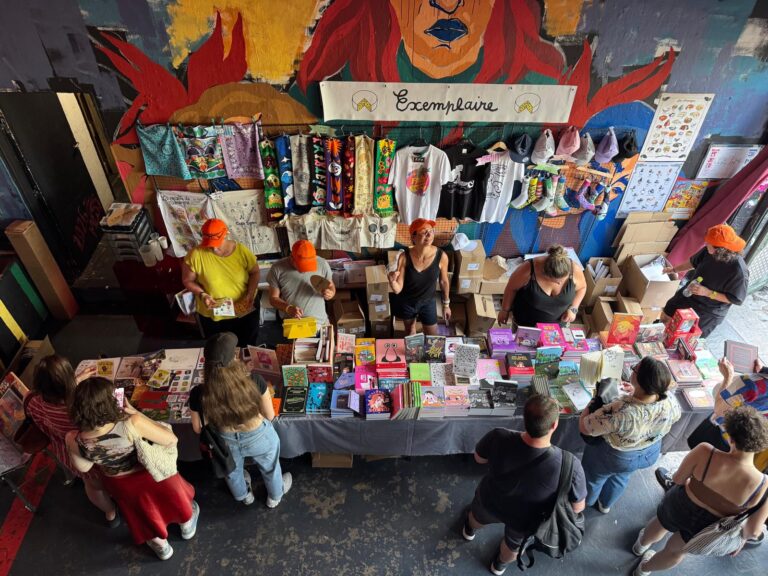
Exemplaire Editions works in a part of publishing where the object itself carries weight. The French publishing house has built its identity around authors, artists and books that feel personal, carefully made and closely connected to the people who create them. For its readers, a book is not only something to buy at a stand. It is often part of a wider relationship with an author’s world.
That made the idea of author-designed scarves feel unusually natural. At events where Exemplaire Editions meets its public, the stand becomes a place for discovery, conversation and direct support. A scarf gives that same audience another way to take the work home. Not as a poster, not as a tote bag, not as a standard promotional item, but as a textile object carrying an author’s visual language.
The project sits well outside the usual world of sports merchandise. Scarves are often linked to terraces, clubs and supporter rituals, but the format itself is broader than football. It is long, highly visible, tactile and generous enough to hold detailed artwork. For a publisher interested in unique literary objects, that made it a surprisingly strong canvas.
Why custom scarves made sense for a publishing house
For Exemplaire Editions, the scarf was not chosen as a simple branded accessory. The strength of the idea came from giving authors a different surface to work on. Each design could carry the personality of a specific creator, turning the product into something closer to wearable art than traditional merchandise.
That distinction is important. Many organisations use merchandise to repeat a logo. Exemplaire used it to extend the author’s work into another format. The scarf became a support for expression, not just a support for visibility.
“The scarves are designed by our authors. It is an original medium for expressing their art, and it often inspires them a lot.”
For readers and followers of the publisher, that gives the product a clear reason to exist. It is not asking someone to buy merchandise because they recognise a name. It offers them a piece connected to an artist they already follow, admire or discover through the publisher’s events.
In practical terms, custom scarves also work well in a stand environment. They are easy to display, visually immediate and large enough to make an impact from a distance. For a publisher selling illustrated work, that visibility matters. Colour, line, rhythm and composition can be seen before the visitor has even picked the product up.
Turning the HD Deluxe scarf into an artistic canvas
The product chosen for the project was the Custom Football Scarf, a scarf format suited to designs that need more precision and colour impact than a basic knitted scarf can provide. For artwork-led projects, this matters because the scarf is judged in a different way.
A football scarf can rely on strong blocks of colour, bold lettering and simple symbols. An author-designed scarf often has a different visual language. It may include illustration, unusual colour combinations, graphic detail or a composition that was never created for a conventional merchandise template.
In projects like this, the production challenge is not to make the scarf look “branded”. It is to keep the artwork alive once it becomes textile. The finished piece needs to feel like the artist’s work has moved onto fabric without losing its character.
Colour was central to the Exemplaire Editions project. The originality of the designs and the vibrance of the colours were part of what made the scarves stand out at events. For a product sold to readers rather than distributed as a giveaway, that visual quality becomes commercial as well as artistic. People need to want the object at first glance.
Across custom scarf projects, the best results usually come when the format is treated seriously from the beginning. A scarf is not a flat sheet of paper. It has texture, edges, weight and a way of folding when worn or displayed. For Exemplaire Editions, those qualities helped the product feel like a finished object rather than a printed reproduction.
Readers interested in similar projects can also explore the wider custom scarves collection, where the same product family can be adapted for clubs, brands, cultural organisations and event campaigns.
Artist approval as the real sign-off
In a conventional merchandise project, approval often comes from a marketing team, a club office or an event organiser. For Exemplaire Editions, the decisive approval sat closer to the artist. The scarf had to satisfy the person whose design it carried.
That changes the emphasis of the project. Technical quality still matters, of course, but the key question becomes more personal: does the finished scarf feel faithful to the artwork? Does the artist recognise their own visual intention in the sample? Would they be proud to see it sold alongside their books?
The response after sampling gave the project its clearest sign of success: “The artist is delighted, so it is approved for us.”
That kind of feedback is small, but meaningful. It shows the product had crossed the line from acceptable merchandise to something the creator could stand behind. For a publisher built around author-led work, that is not a detail. It is the foundation of the project.
This is also where experience with textile merchandise becomes useful. Artwork cannot always be treated the same way on fabric as it is on screen or paper. Contrast, colour density, edge definition and scale all influence the final result. A good custom scarf project protects the intent of the design while adapting it to the realities of the product.
With Exemplaire Editions, the process worked because the scarf was treated as a creative object. The aim was not to simplify the authors’ designs into generic merchandise. It was to produce a textile version that still felt expressive.
Why the project worked commercially without feeling conventional
The commercial success of the scarves came from the fact that they did not feel like standard promotional scarves. They were not built around a slogan or a generic logo placement. They were rooted in the publisher’s creative world.
“The item is a great success with our audience. That is why we order them from you regularly.”
That repeat-order context is one of the strongest parts of the story. A first order can be an experiment. A regular order means the product has found its place with the audience.
For Hercules Merchandise, this kind of project is a reminder that custom scarves are not limited to clubs and sports organisations. The same manufacturing knowledge used for supporter products can be applied to cultural projects, publishing merchandise, art-led campaigns and event retail. The product works when the idea behind it is strong enough and the final object feels worth buying.
It also shows why product choice matters. A low-quality item would weaken the concept. If the scarf is meant to carry an artist’s work, it has to feel considered. The material, finish and colour result all contribute to whether the audience sees it as a proper object or a simple add-on.
For publishers, galleries, cultural festivals and creative agencies, that is the real value of the case. A textile product can give artwork another life, but only if the format respects the work.
A creative use of custom scarves beyond sport
The Exemplaire Editions project is a strong example of custom scarves moving into a different cultural setting. The same product language that works for supporter merchandise can also work for readers, collectors and art-led communities when the design has a clear purpose.
For Exemplaire, the scarves created a new surface for authors. For the audience, they became colourful, collectable objects that could be bought at events and connected back to the artists behind the books. For Hercules Merchandise, the project showed how textile merchandise can support a creative publishing house without forcing it into a sports-style template.
That is why this collaboration stands out. It used custom scarves in a way that felt specific to the organisation, the authors and the public around them. The product worked because it belonged to the project, not because it followed a standard merchandise formula.
For cultural organisations exploring custom scarves, custom HD scarves or event merchandise with a more artistic use case, the best starting point is not the product catalogue. It is the question Exemplaire Editions answered well: what would make this object feel genuinely connected to the people creating the work and the audience buying it?
For similar projects, Hercules Merchandise can help translate artwork, event context and audience expectations into a finished textile product. The process starts with the idea, the artwork and the intended use, then moves towards the right scarf format. You can contact the team here.
Article written by Gilles
Founder of Hercules Merchandise, specialising in custom sports merchandise for clubs and organisations.