


































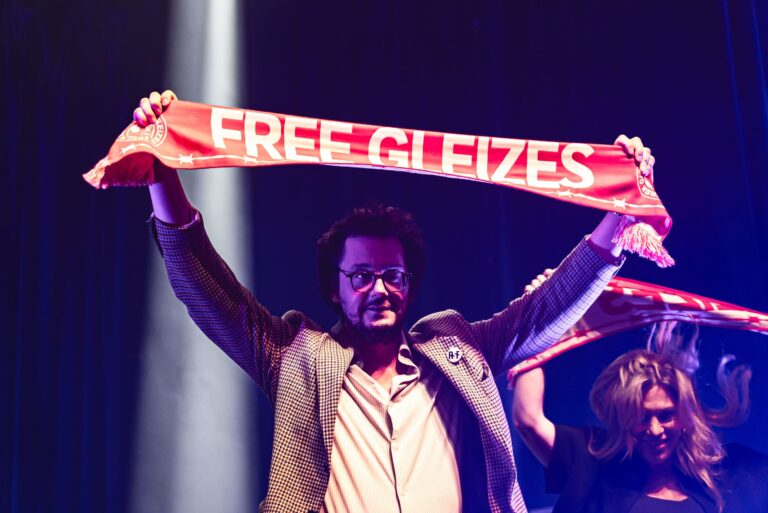
Reporters Without Borders works in an area where public attention is essential, but rarely easy to maintain. Campaigns defending press freedom often need to make complex situations visible, even when those situations feel distant from everyday public life. For the FREE GLEIZES campaign, the objective was clear: support Christophe Gleizes, a French sports journalist, and publicly carry the call for his release.
Christophe Gleizes is not an abstract name in sports journalism. A contributor to So Foot and Society, he became known for field reporting, especially around African football. His work has often taken him into stories where sport reaches beyond the match itself: player journeys, social realities, popular clubs, and the connections between football and place.
His trip to Algeria followed that same reporting logic. He was working in particular around Jeunesse Sportive de Kabylie, the historic club from Tizi Ouzou, and the story of Albert Ebossé, the Cameroonian striker who died in 2014 after a JSK match. It was in this journalistic context that he was arrested in Tizi Ouzou, before being placed under judicial supervision and banned from leaving Algerian territory.
On 29 June 2025, Christophe Gleizes was sentenced to seven years in prison in Algeria. The accusations related to “glorifying terrorism” and the “possession of publications for propaganda purposes harmful to the national interest”, linked to old contacts with a football official in Tizi Ouzou who was also associated with the Movement for the Self-Determination of Kabylie, classified as a terrorist organisation by the Algerian authorities in 2021. RSF strongly contests the conviction and presents his case as that of a journalist imprisoned for doing his job.
This is the story that gave the scarf its meaning. RSF presented Christophe Gleizes as a sports journalist sentenced to seven years in prison for informing the public. The campaign therefore needed an object capable of carrying a simple, visible and immediately recognisable message.
The scarf answered that need well. It could be worn, photographed, held up, sold through the RSF shop and used as a sign of collective support. In the words of the campaign, it allowed people to “show the colours”, “carry the message everywhere” and remind others that “the match for press freedom is not over”.
Hercules Merchandise became involved once this intention was clearly defined. The role was not to create a simple promotional product, but to turn an idea of public mobilisation into a credible, readable and campaign-ready woven scarf.
Christophe Gleizes, a story connected to football and reporting
The strength of the FREE GLEIZES campaign comes partly from Christophe Gleizes’ own path. His profile made the use of a supporter scarf especially coherent. This was not a case of applying a sports code to a cause with no connection to sport. Sport was already part of the story.
As a football-focused reporter, Christophe Gleizes has worked on subjects where the ground matters as much as the result. Clubs, cities, players and supporters are often the entry points for his stories. In his work, football is not only a beat. It is a way of telling stories about societies, human journeys and local tensions.
His reporting in Algeria focused in particular on JS Kabylie, a major club from Tizi Ouzou with a strong connection to Kabyle identity, as well as on Albert Ebossé, whose death in 2014 remains a sensitive subject. This context helps explain why the campaign for his release quickly resonated within football and sports journalism.
After his conviction, Christophe Gleizes was imprisoned in Algeria, in Tizi Ouzou. For RSF, his case represents a wider issue: the defence of the right to investigate, meet sources and work as a journalist without that work being criminalised.
The FREE GLEIZES scarf was never meant to replace the substance of that mobilisation. It simply gave the public a visible way to take part in it.
A solidarity campaign led by RSF
RSF is one of the leading international organisations defending press freedom. Its work is built around public campaigns, advocacy and practical support for threatened or imprisoned journalists. With FREE GLEIZES, that mission took shape around a specific case.
The particular nature of the mobilisation also came from Christophe Gleizes’ profile. His work as a sports journalist gave the campaign a natural link to the world of sport, without needing to turn it into a conventional football operation. The supporter scarf made it possible to use familiar language: colours, stands, support and a message carried collectively.
This link with football was not theoretical. The mobilisation around Christophe Gleizes also found echoes in the football world, including clubs and institutions that publicly expressed their solidarity. In that context, the important date planned in Lens gave the scarf a very concrete role: a visible object, ready to be worn or shown at the moment when the campaign needed to be recognised.
Lens is not a neutral city when it comes to popular support. Racing Club de Lens is associated with one of the most recognisable terrace cultures in France. Without turning FREE GLEIZES into a club campaign, that context made the use of a scarf especially easy for the public to understand.
RSF did not use those codes to imitate a club. The objective was more direct: give supporters an object they could understand immediately and use without a long explanation. Buying the scarf, wearing it or showing it meant joining a public mobilisation.
This logic explains why the scarf had its place in the RSF shop. It worked as a solidarity product, a campaign object and a fundraising tool, with proceeds going to RSF and the campaign for Christophe Gleizes’ release.
Why a custom scarf was the right format
A custom scarf works well when a message needs to be visible. It gives presence to a phrase, to colours and to a cause. Unlike a badge or flyer, it can be worn in the street, held in front of the body, shown in a photograph or kept as a campaign object.
For RSF, the scarf had to do several things at once. It needed to carry the FREE GLEIZES message, echo the world of sport, remain accessible to supporters and serve as a solidarity product sold online. The supporter format naturally brought those needs together.
This is also what makes custom scarves interesting beyond clubs and terraces. Their visual language is familiar, but their use can change. A scarf can support a team, mark an event, accompany a campaign or give a shared visibility to a group of people.
RSF summarised this intention very clearly:
“Out of this mobilisation came a supporter scarf: to show the colours, carry the message everywhere and remind people that the match for press freedom is not over.”
What this campaign can teach organisations
The FREE GLEIZES scarf shows that a strong campaign product begins with context. RSF had a clear cause, a short message, a natural link with sport through Christophe Gleizes and a community of supporters ready to share the mobilisation.
The project also reminds us that merchandise should not be treated as simple decoration. When the product is well chosen, it gives the public a way to participate. It helps a message move beyond press releases, social media posts or campaign pages and become visible in more everyday spaces.
In sports merchandise, the most effective objects are not always the most complex. They are often the ones that are understood immediately. The RSF scarf achieved that because it connected a familiar format with a clear message.
For Hercules Merchandise, this project shows how a custom supporter scarf can move beyond the usual setting of clubs and matchdays. In the right context, the same format can become a campaign object, a solidarity product and a public sign of mobilisation.
The scarf did not need to tell the whole story. It needed to carry the message clearly, give supporters a credible object to wear and make the campaign more visible. For FREE GLEIZES, that was precisely its role.
Article written by Gilles
Founder of Hercules Merchandise, specialising in custom sports merchandise for clubs and organisations.