
























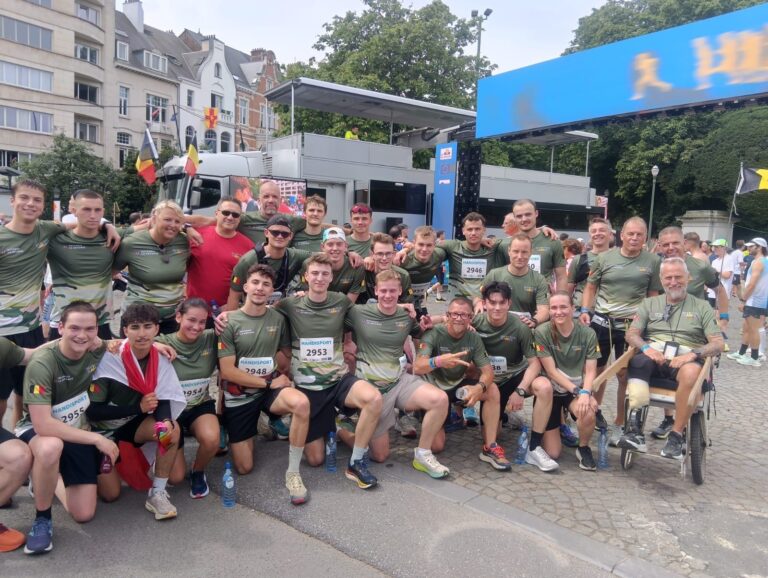
At the 20 km de Bruxelles, the Belgian Defence group linked to Invictus Team Belgium stood out for more than their shirts. They were there as a team, moving through the city with wounded military personnel, students from the Royal Military School / École Royale Militaire, supporters and volunteers all playing their part in the same effort.
The run carried a clear message. It was about resilience, but not in the abstract way that word is often used. It was about people physically supporting one another across 20 kilometres, including the carrying of joëlettes so wounded soldiers could take part in one of Belgium’s best-known public running events. Every kilometre depended on coordination, commitment and trust.
For the participants, the day was not built around individual performance. The focus was on finishing together. Students from the Royal Military School helped carry and support their comrades along the route. Members of Invictus Team Belgium and Belgian Defence moved as one group, surrounded by spectators and encouraged by people along the course. ASBL Tous à Bord also played a role in making the handisport start more inclusive and accessible.
That collective character shaped the whole project. The shirts needed to fit into the reality of the event: a public race, a mixed group of participants, a strong Belgian Defence identity and a team whose presence had to be recognisable in a crowd. These were not retail products or official race merchandise. They were custom printed running shirts made for people taking part in a specific moment, with a specific purpose.
The challenge was practical from the beginning. The shirts had to be comfortable enough for the 20 km de Bruxelles, clear enough to identify the group and strong enough visually to carry the right logos during a busy public event. In a race where spectators see participants in motion, often from the side or from behind, the design could not only look good on a flat mock-up. It had to work in the street.
Hercules Merchandise became involved once Belgian Defence had already defined the need. There was an initial visual direction, created internally, and the task was to turn that idea into a polished sublimated sports shirt. The project became a useful example of how custom printed sportswear can support a meaningful event without making the product the centre of attention.
A public race with a team built around support
The 20 km de Bruxelles is not a quiet setting. It is a large urban race, with participants passing through the city in front of spectators, supporters, volunteers and photographers. For a group like Belgian Defence and Invictus Team Belgium, that visibility was part of the experience.
A team running in this context is seen constantly, but rarely in perfect conditions. Spectators catch a glimpse as runners pass. Supporters take photos from crowded pavements. Other participants see shirts from behind. A logo that looks readable on screen can disappear quickly once it is moving through a mass event.
For Belgian Defence, visibility had a practical role. The shirts needed to help people recognise the group during the race. They also had to create a shared look for participants who were taking part in different ways: running, supporting, carrying and encouraging.
The presence of joëlettes gave the event an extra layer of teamwork. Carrying a joëlette for 20 kilometres requires organisation and physical effort, but it also creates a visible symbol of solidarity. The group was not only talking about inclusion; they were putting it into action across the route.
In that setting, the shirts helped bring the group together visually. They gave the team a consistent identity without distracting from the real story: wounded soldiers, military students, volunteers and supporters moving through Brussels together.
Turning an internal idea into a finished shirt
The first design direction came from Belgian Defence. It was not a finished production file, but it gave the project a clear starting point. The colours, logos and general intention were already there. What the project needed was refinement.
This is a common situation in custom sportswear. Many organisations begin with a rough idea rather than a final design. A club may have a badge and sponsor logo. A charity may have event colours and a message. A military or sports organisation may know exactly what the product is for, but still need help translating that into something balanced and production-ready.
For this project, Hercules created several design proposals for sublimated sports t-shirts. The design process was not about starting again from scratch. It was about respecting the original idea and improving the way it would work on the final garment.
Sublimation was a logical choice for this type of shirt. It allows the full design to be printed into the fabric, instead of adding heavy transfers on top. For running shirts, that matters. The garment needs to stay light, comfortable and flexible, while still carrying the visual identity clearly.
The shirt also had to include several logos without looking overloaded. That balance is always important in sports event merchandise. Too little branding and the shirt loses its purpose. Too much, and it starts to look messy. The strongest event shirts usually sit somewhere in the middle: clear, readable and designed around how they will actually be used.
Why the back of the shirt mattered so much
The key design decision came when Belgian Defence asked for the logos on the back to be made larger. The reason was simple: spectators at the 20 km de Bruxelles needed to be able to see them.
That request says a lot about the project. The back of a running shirt is often more important than people realise. In a race, spectators may see participants from behind for longer than they see them from the front. Photos are taken from every angle. Supporters on the route often watch a group pass and continue following them visually as they move away.
For a team linked to Belgian Defence and Invictus Team Belgium, the back of the shirt had to carry meaning. It needed to identify the group clearly during the race and make the logos visible without making the whole design feel crowded.
The final result was still clean. The shirt did not need to shout. It needed to be readable, appropriate and connected to the group wearing it.
Why sleeved sublimated shirts were the right format
The final order was for 40 sleeved sublimated sports t-shirts. The choice of a sleeved shirt was important, especially because running events often use running singlets as well.
A singlet can be a good option for competitive running, but it gives less design space and creates a different look. For this project, a sleeved t-shirt made more sense. It offered more room for logos, colour balance and visual structure. It also felt more like teamwear, which suited a Belgian Defence group taking part together.
The shirt had to serve a mixed group, not a narrow performance squad. It needed to look coordinated on different body types, work during a long route and carry enough identity to be recognisable in public. A sleeved sublimated t-shirt gave the design more flexibility.
Before production, a test print was reviewed. This step helped confirm that the design direction was working before the full order moved ahead. In custom sportswear, test checks are not just a formality. They are often where the final confidence comes from.
A design can change once it leaves the screen. Colours, logo scale, print placement and garment shape all affect the final result. For a project connected to a public event, there is little room for guesswork. The shirts have to be ready when the event arrives.
For Hercules, this is where production experience becomes useful. The design team can help translate an idea into a strong visual, but the product also has to make sense as a garment. It needs the right format, the right scale, the right logo placement and the right level of detail for the way it will be used.
Custom sportswear with a clear job to do
The Belgian Defence project worked because the purpose was clear from the start. The shirts were not created as general promotional clothing. They were made for a team taking part in the 20 km de Bruxelles, with wounded military personnel, students and supporters connected by the same effort.
The product had a supporting role. It helped the group look unified. It made the Belgian Defence and Invictus Team Belgium presence easier to recognise. It carried the right visual identity through the streets of Brussels, while the real focus remained on the people completing the event together.
This is often where custom event merchandise is most effective. It does not always need a large campaign or a broad product range. Sometimes the right product is a well-designed shirt, scarf or team item that helps people show up as a group.
For clubs, charities, event organisers and sports organisations, the lesson is practical. Start with the event. Think about who will wear the product, who will see it and what needs to be recognised. Then choose the format that supports those needs.
The product changes, but the thinking stays the same.
In this case, custom sublimated running shirts were the right answer because they matched the event. They gave Belgian Defence a visible team identity during the 20 km de Bruxelles without turning the shirts into the main story.
Conclusion: a shirt designed around the people wearing it
The custom sublimated running shirts for Belgian Defence were created for a very specific moment: a group linked to Invictus Team Belgium taking part in the 20 km de Bruxelles, supporting wounded military personnel and crossing the city together.
The project moved from an internal visual to a finished set of 40 sleeved sublimated t-shirts. Along the way, the most important decisions were practical ones: choosing the right shirt format, refining the design, checking the print and making the back logos large enough to be seen by spectators.
Those details matter because eventwear is judged in real conditions. It has to work in motion, in photographs, in crowds and at the finish line. For Belgian Defence, the shirts helped give the group a shared visual identity while keeping the focus where it belonged: on teamwork, solidarity and the people completing the 20 km together.
Organisations planning similar participant shirts, charity eventwear or team sportswear can explore the Hercules custom printed sportswear range or contact Hercules to discuss the right format for their event.
Article written by Gilles
Founder of Hercules Merchandise, specialising in custom sports merchandise for clubs and organisations.