




























Brussels Beer Project is used to building its brand in public spaces. Its beers, taprooms and community-led energy make sense in places where people gather, talk, watch, taste and share. For a Brussels beer brand, the World Cup offered a very natural setting for that kind of visibility.
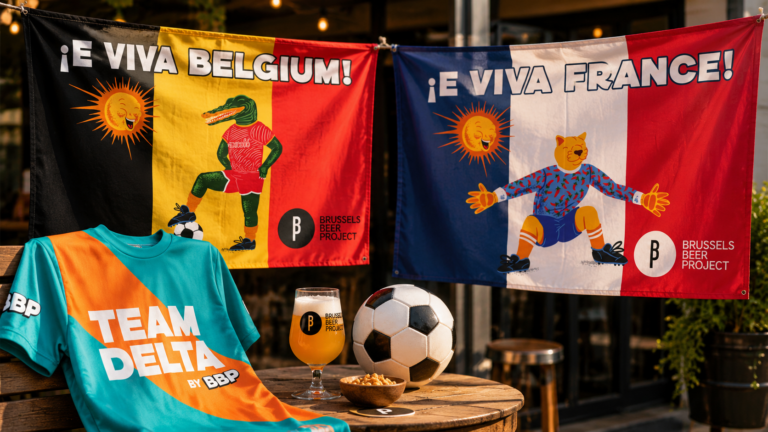
The activation had a clear commercial purpose. Brussels Beer Project wanted World Cup merchandise for French and Belgian audiences, with different designs for each country. The project was not simply about putting a logo on a giveaway. It was about creating branded supporter products that could sit comfortably around football, beer and national identity without feeling detached from the moment.
The brand already had internal mockups that had been used by its commercial team, so the product needed to follow an existing idea closely. In the customer’s own words, the World Cup activation was “one of our major priorities this year.” That gave the project a different weight from a standard promotional order.
Hercules Merchandise became involved once the need was clear: turn those market-specific ideas into finished custom World Cup flags that could support the activation across Belgium and France.
Why custom World Cup flags fitted the activation
Flags are one of the most direct forms of football event merchandise. They are visual, easy to distribute and immediately connected to the way supporters show allegiance during tournaments. For a beer brand working around the World Cup, that made them a practical choice.
Brussels Beer Project was not trying to behave like a football club. The brand needed merchandise that could borrow from supporter culture without pretending to be official teamwear. Custom flags and pennants offered that balance well. They could carry BBP’s own branding while still feeling natural in match-day settings, bars, fan gatherings, partner activations or sales conversations.
The country split was central. France and Belgium bring different football references, colours and supporter expectations, so one generic design would have weakened the activation. Separate French and Belgian flag versions allowed the merchandise to feel more relevant to each audience.
For brands working around major tournaments, this is often where the product choice becomes important. The best football event merchandise is not always the most complex item. It is usually the product that fits the audience, the setting and the speed of the campaign.
From a broad merchandise idea to a focused flag order
The project began with several possible product directions. Brussels Beer Project explored large custom flags, personalised caps and giant foam hands for the World Cup activation. Each product had a different role: flags for visibility, caps for wearable merchandise, foam hands for a more playful fan item.
As the project developed, the focus became sharper. Caps were discussed, including the practical choice between embroidery and printing. With detailed logos and visuals, printing was the better route for clean reproduction. Custom headwear can work well for sports campaigns, but only when the design method suits the artwork.
Foam hands also fitted the early World Cup idea, especially for a lively fan-facing activation. In the end, Brussels Beer Project chose to move forward with flags only. That decision made sense. Rather than spreading the budget and attention across several product types, the brand concentrated on the item that best matched the visual nature of the campaign.
The final order covered French-branded and Belgian-branded flags in a 100 x 65 cm format. The finish was kept simple and practical: stitching around the full edge, with no sleeve and no eyelets.
Keeping the mockups close to the finished product
A useful part of this project was the role of the internal mockups. Brussels Beer Project had already used those visuals commercially, so consistency mattered. If a sales team has presented a product in a certain way, the finished merchandise needs to stay close enough to that promise.
That is where artwork preparation becomes more than an admin step. For custom World Cup flags, the design has to work at final size, with the right file format and colour approach. Vector artwork, final-size files and CMYK preparation all help reduce surprises between screen visuals and the product that arrives in boxes.
This is especially true for flags. A flag is a simple object, but it is unforgiving visually. It is usually seen quickly, from a distance, in movement or as part of a wider display. If the contrast is weak or the branding feels unclear, the product loses much of its value.
Across sports merchandise projects, the strongest results often come when the design ambition and the production method meet properly. Brussels Beer Project had a clear brand idea. The job was to protect that idea through the technical choices, rather than overcomplicate it.
What the 20 km de Bruxelles shirts added to the wider story
The World Cup flag project was the main football activation, but Brussels Beer Project’s use of branded sports merchandise did not stop there. The brand also ordered running shirts for the 20 km de Bruxelles, one of the city’s best-known running events.
That separate project shows a different side of BBP’s merchandise thinking. The World Cup flags were about national football audiences and supporter visibility. The running shirts were about branded sportswear in motion, worn by people taking part in a real event.
For the shirts, Brussels Beer Project selected a standard model with double stitching after reviewing samples. The order used the brand’s logos, font and colours, with the visual checked before production. Custom printed sportswear has to work differently from flags because the product is worn, washed, photographed and experienced physically during activity.
A later small reorder also showed how merchandise can reveal things once it leaves the production process. BBP changed the back slogan to “FAST & THIRSTY” after feedback from women runners showed that the previous wording no longer felt right in practice. The change was handled quickly and practically, and it gave the project a useful reminder: branded sportswear is not just seen, it is lived in.
A beer brand using sports merchandise with purpose
Brussels Beer Project’s projects worked because they were tied to real situations. The World Cup flags had a clear audience, a clear campaign and a clear split between France and Belgium. The 20 km shirts had a different role, connected to participation, movement and visibility during a Brussels sporting event.
That distinction matters for brands outside traditional sport. Breweries, agencies, sponsors and consumer brands can all use sports merchandise well, but only when the product fits the occasion. A flag makes sense around a World Cup activation. A technical shirt makes sense for a running event. A cap or foam hand may work for another campaign, but only if the artwork, audience and use case support it.
The Brussels Beer Project work is a good example of merchandise acting as part of the event environment rather than sitting beside it. The flags were not presented as general corporate giveaways. They were created for a football moment, with country-specific branding and practical finish choices that supported the campaign.
For Hercules Merchandise, that is often where the most effective projects sit. The product itself is important, but the surrounding context decides whether it becomes useful. A well-made flag, shirt or other item only earns its place when it helps the customer show up in the right way.
What other brands can take from the project
The strongest lesson from Brussels Beer Project’s custom World Cup flags is the value of focus. The brand began with several possible merchandise ideas, then chose the product that best supported the activation. The French and Belgian versions gave the campaign more relevance, while the production details helped keep the final result close to what the commercial team had already presented.
The later running-shirt work added another layer. It showed BBP using merchandise across different sports contexts, from football supporter visibility to event apparel for a Brussels running race. Both projects were grounded in real use, not abstract brand storytelling.
For brands planning football event merchandise, custom sports merchandise or campaign products around major events, that is a sensible way to think. Start with the audience and the setting. Choose the product because it belongs there. Then make the design and production decisions that help it do its job.
To discuss a similar project, contact Hercules Merchandise.
Article written by Gilles
Founder of Hercules Merchandise, specialising in custom sports merchandise for clubs and organisations.