



































Dorothy came to Hercules Merchandise with a scarf project that sat outside the usual world of club merchandise. The brief was not about supporter scarves for a team, or a giveaway for a one-off event. It was about using the half-and-half scarf format as a creative product in its own right.
Dorothy is a Liverpool-based creative studio with an online shop built around design-led prints, products and artworks. Its work often draws on music, film, literature, art and pop culture, turning familiar references into objects people can collect, display or gift. That made this scarf project a natural fit for the studio’s wider world. The scarves were not simply merchandise with a logo added. They were designed products, created to sit alongside Dorothy’s existing shop, exhibition activity and public-facing product collections.
The studio wanted custom jacquard scarves for an exhibition. The scarves also needed to be ready early enough for product photography, website preparation and a public launch through Dorothy’s own webshop. That gave the project a clear commercial and visual purpose from the beginning.
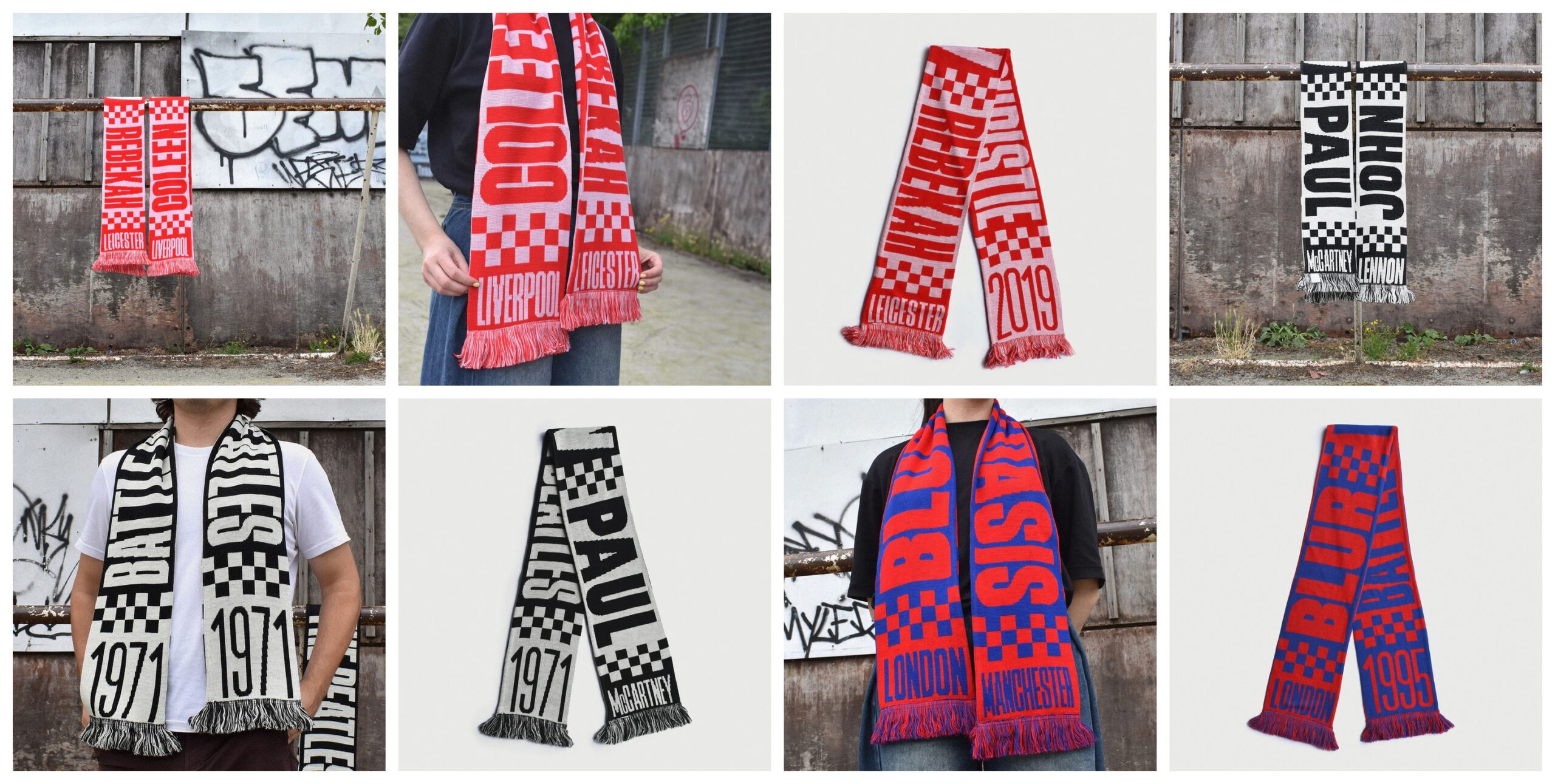
What made the project interesting was the way Dorothy used a familiar scarf format for a very different kind of story. These were half-and-half scarves, but not in the normal matchday sense. Instead of two football teams, the designs played with famous pop culture rivalries: The Battle of Britpop, The Battle of the Beatles and Coleen Vs Rebekah.
A half-and-half scarf format used beyond football
The half-and-half scarf is strongly associated with football. It usually marks a fixture, a rivalry, a final or a particular matchday moment. Dorothy took that visual language and moved it into a more design-led space.
That shift made sense for the collection. The products still carried the split structure people recognise from football scarves, but the subject matter came from music, celebrity culture and public drama. The result was a product that felt familiar in format but playful in content.
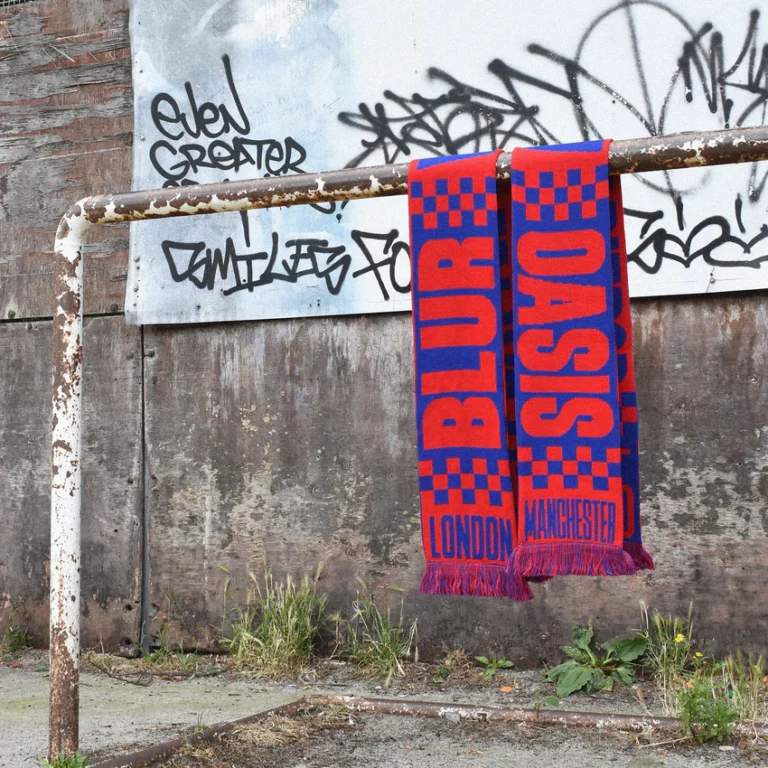
Dorothy’s public collection included three designs. The Battle of Britpop looked back at Blur versus Oasis in 1995, when both bands released singles on the same day and created one of the best-known chart battles in British music. The Battle of the Beatles focused on John versus Paul in 1971, after the band’s public fallout and the legal and lyrical exchanges that followed. Coleen Vs Rebekah took on Wagatha Christie, the modern pop culture feud that played out publicly and in court.
That range gave the scarves a clear editorial feel. They were not simply decorative items. Each one carried a reference that people could recognise, debate and choose a side on. In that sense, the half-and-half structure was doing real work. It turned each scarf into a designed object with a built-in conversation.
For Hercules Merchandise, the project showed how custom scarves can move beyond traditional sport use. The format still has all the strength of a scarf: scale, texture, colour and visibility. Dorothy used those qualities for a retail and exhibition product rather than a club shop or stadium setting.
Designing scarves for photography, retail and launch
Dorothy’s project had a different kind of pressure from many event merchandise orders. The scarves needed to look good not only in hand, but also in photographs, on product pages and as part of a public collection launch.
That matters because a scarf sold as a design product is judged differently from one handed out at an event. The spacing, colours and finish all have to hold up under closer attention. Dorothy was clear about this throughout the project. The team wanted the finished pieces to stay as close as possible to the original proof.
That level of care is important in design-led merchandise. When a customer has a strong visual idea, the production process needs to protect it. The job is not to reinterpret the artwork, but to translate it into a knitted product while keeping the balance, rhythm and intent of the design intact.
Timing also played a part. The scarves were needed ahead of an exhibition, with enough time for Dorothy to receive them, photograph them and prepare the online product pages before launch. They were not simply being delivered as stock. They were part of a wider launch schedule.
Why jacquard scarves made sense for the project
Dorothy compared different scarf options before deciding on the final route. The team liked the softer, stretchier feel of the HD football scarf, but for this collection jacquard became the better fit.
That choice suited the project. Jacquard scarves work well for bold graphic ideas, typography, repeat patterns and designs that benefit from a woven, tactile finish. For a half-and-half scarf collection, they also bring the right sense of familiarity. The product still feels connected to traditional scarf culture, even when the subject matter moves into music, pop culture and public rivalries.
The production choice also helped bring the three designs together. Each scarf had its own cultural reference, but the shared format, yarn approach and finish allowed them to sit naturally as one coherent collection.
That was important because Dorothy was not producing one isolated item. The scarves had to work as individual designs, but also as a small range prepared for photography, exhibition use and public launch.
From exhibition product to stockist interest
After production, Dorothy launched the half-and-half scarves publicly on its website. The customer later wrote: “We have just launched our half and half scarves that you produced for us, they look great! :)”
That was the clearest outcome from the first stage of the project. The scarves had moved from concept to production, then into photography, product pages and public launch.
The story did not end there. After the launch, Dorothy came back to request a quote for more scarves of one design, The Battle of the Beatles. A stockist had enquired about potentially taking some of the scarves. That detail is useful because it shows the scarves working beyond the initial exhibition requirement.
For a creative studio, stockist interest can be an important signal. It means the product is not only meaningful internally or visually successful on a website. It has potential as a retail object that someone else can imagine carrying.
This is where custom merchandise can become more than a project expense. When the product is strong enough, it can support a launch, create content, sit inside a collection and open up further commercial opportunities.
What other creative brands can learn from Dorothy’s scarves
Dorothy’s project is a strong example of custom jacquard scarves being used as design objects rather than standard merchandise. The scarf format was familiar, but the concept changed its meaning.
That is the lesson for studios, cultural brands, artists and retailers. A scarf does not have to belong only to football clubs or sports events. Used well, it can carry an idea, mark a cultural reference, support an exhibition or become part of a product collection.
The key is to understand what the scarf needs to do. For Dorothy, it needed to work visually, photograph well, feel credible as a retail product and hold up across three different designs. The format, yarn choice, spacing and finish all had to support that purpose.
For Hercules Merchandise, the project was a reminder that some of the most interesting scarf work happens outside the expected categories. A half-and-half scarf can still carry the energy of a rivalry, but the rivalry does not have to come from football. It can come from music, culture, celebrity, history or any story where people instantly understand the sides.
If you are developing a scarf collection for an exhibition, retail launch or cultural project, you can discuss options with Hercules Merchandise through our contact page.
Photo credit: Dorothy
Article written by Lea
Project manager for UK and Germany