































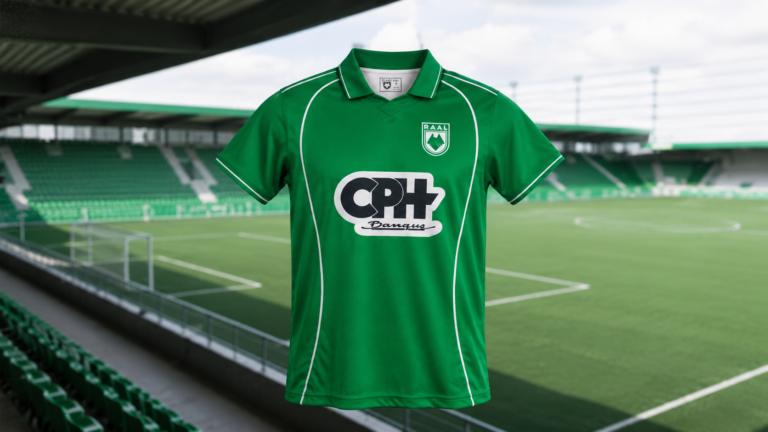
RAAL La Louvière came to Hercules Merchandise with a clear idea: create custom retro football shirts linked to the club’s 2003 Belgian Cup victory.
The brief was specific from the beginning. RAAL wanted a vintage football shirt with a polo collar, short sleeves and no shorts, based on a historic reference that supporters would recognise. The shirts were intended to be sold around the RAAL match against Antwerp on 6 March, so this was not a generic teamwear order. It was supporter merchandise built around a date, a memory and a club identity.
For RAAL, the 2003 cup win is not just another archive reference. It remains the club’s biggest national achievement and a useful anchor for a club that has been rebuilding with real momentum. Since the takeover and revival of the club project under Salvatore Curaba, the story around RAAL has been one of reconstruction, ambition and return. The club has since moved into a completely newly built stadium, the Easi Arena, and recently earned promotion to Belgium’s top division, giving the retro shirt project an extra layer of relevance.
This was a good example of what custom retro football shirts can do when they are treated as supporter merchandise rather than simply playing kit. The product needed to look right, feel credible and carry enough detail to make the reference work for fans who remembered the original era.
A retro shirt for a club rebuilding with momentum
RAAL La Louvière has one of those football stories where the past and present sit very close together. The club’s own history explains how the modern RAAL project was rebuilt after several difficult years for football in La Louvière, with Salvatore Curaba playing a central role in recreating the club’s historic identity.
That background matters because this shirt was not created in isolation. A retro shirt linked to 2003 makes more sense when the club is also moving forward quickly. RAAL’s return to the top level of Belgian football added a fresh context to a product built around an older achievement.
The move into the completely newly built Easi Arena also adds to that sense of a club entering a new phase. A stadium is not only a place to play matches. For a club shop, a fan zone or a matchday sales point, it becomes the place where a product is physically introduced to supporters.
For clubs in this position, merchandise has to do more than carry a badge. Supporters can usually tell when a retro product has been built around a real story and when it has simply borrowed the word “retro” as a style. RAAL’s team approached the project with the right level of care. The shirt needed to refer back to 2003 without looking like a loose imitation.
The Belgian Cup memory behind the shirt
The 2003 Belgian Cup final remains the key reference point for this project. RAA Louviéroise beat Sint-Truiden 3-1 at the King Baudouin Stadium, winning the Belgian Cup for the first time in the club’s history.
For an article like this, the wording around the historic identity needs to be handled carefully. The current RAAL project carries the memory and visual culture of football in La Louvière, while the administrative history of the club has had its own complications. From a supporter merchandise point of view, the central fact is simple enough: RAAL wanted to create a shirt inspired by the cup-winning memory that still means something to its fanbase.
That kind of reference gives a retro product a much stronger base. A vintage-style shirt can look attractive on its own, but when it is linked to a specific match, season or achievement, it becomes easier for supporters to understand why it exists. The design is not just old-looking. It points to a moment.
In our experience producing sports merchandise, the best retro products usually start with a narrow reference. A club crest, a collar shape, a sleeve band, a sponsor layout or a colour from an old shirt can carry a lot of meaning if the rest of the product is handled properly. RAAL’s project had that focus from the start.
What clubs can learn from RAAL’s retro shirt project
RAAL’s project is useful because it shows how much difference a clear reference can make. The club did not ask for a vague vintage design. It came with a specific achievement, a specific shirt style and a specific sales moment.
For clubs planning custom retro football shirts, the first question should not be “Can we make something retro?” A better starting point is “Which memory are we bringing back, and why would supporters care now?” RAAL had a strong answer: the 2003 Belgian Cup victory, brought back during a period when the club itself was moving into a new chapter.
The second lesson is to respect the details that supporters associate with the original. In RAAL’s case, the collar, sleeve bands, logo outline, back curve and neck size marking all played a role. None of those elements would carry an entire product by itself. Together, they helped the shirt feel more credible.
The final lesson is commercial. A retro shirt is strongest when it has a moment to belong to. RAAL connected the shirt to the Antwerp match, sold it through a supporter context and later confirmed that the shirts sold well. That is a simple structure, but it is one many clubs can use.
For clubs, agencies or organisers looking at a similar project, the best starting point is usually the story behind the product. Once that is clear, Hercules can help translate it into the right garment, artwork approach and production route. For a first discussion, clubs can contact Hercules Merchandise with the historic reference, event date and intended use.
A supporter product that belonged to the moment
The RAAL La Louvière project worked because it stayed close to the club’s own story. The custom retro football shirts were inspired by a real achievement, refined through specific design feedback and sold around a real matchday context.
It also arrived during a wider moment of renewal for the club. RAAL had rebuilt its identity, moved into a completely newly built stadium environment and returned to the highest level of Belgian football. Against that background, a shirt connected to the 2003 Belgian Cup victory felt like more than a nostalgic product. It became a practical piece of supporter merchandise linking an old high point with a new phase.
For Hercules Merchandise, this is the kind of project where the details matter. The right product, the right reference and the right sales moment all helped the shirt do its job. RAAL wanted something supporters could recognise. The fact that the shirts sold well afterwards says the idea landed where it needed to.
Looking for another type of custom printed sportswear? Hercules also produces custom printed sportswear for clubs, events and organisations looking for branded garments beyond retro football shirts.
Article written by Gilles
Founder of Hercules Merchandise, specialising in custom sports merchandise for clubs and organisations.